
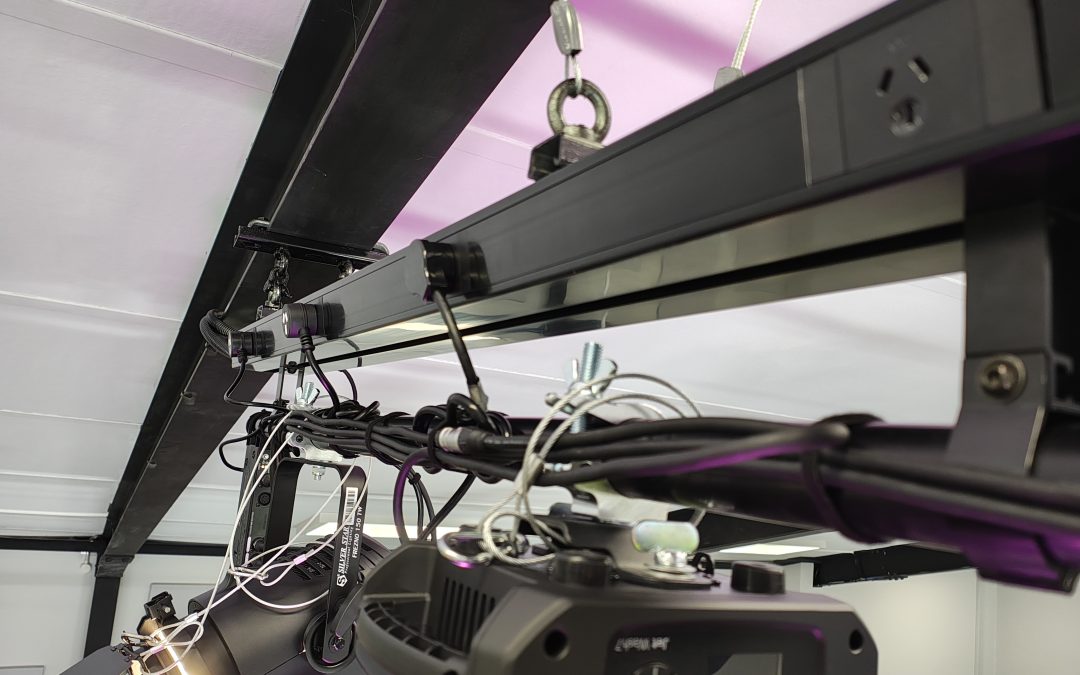
Earth Leakage Protection and the Design of Wired Lighting Bars
In our last article we looked at the phenomenon of earth leakage, the various ways it can be caused, and the fact that the protection of electrical (lighting) circuits must now include protection against electric shocks via the detection of earth leakage currents, in addition to the protection of the circuit against overload.
As we noted in the last article, an earth leakage protection device (RCD or RCBO) must trip at a value between 15mA and 30mA, with real world operating values typically in the 20-25mA range.
Most LED fixtures contain a Switch Mode Power Supply (SMPS), fitted with an EMI filter that produces a small amount of earth leakage current. The permissible limit for earth leakage current in an SMPS in Australia is 3.5mA, however, it is rare to see values this high. In practice, we see values in the 1 – 2mA range, even in the most budget-friendly generic devices.
This wasn’t always the case, (SMPS design has come a long way in the last decade or 2) so if you own some fixtures with a “vintage” SMPS, don’t be surprised if you see values up around the permissible limit.
Let’s look at some worked examples to see how earth leakage can affect the design of wired lighting bars.
Example 1) A wired lighting bar in a theatre with 12 x 10A socket outlets, for theatrical luminaires.
If these 12 socket outlets are each connected to their own circuit, wired to a multi-channel dimmer/relay/power distribution array, then each outlet is protected by its own 30mA RCD, so earth leakage in any one circuit will only likely trip a 30mA RCD in the event of an equipment/wiring fault or an electric shock.
However, if these 12 socket outlets are to be used for small to medium power LED fixtures, while a single circuit could provide sufficient power to the fixtures, all 12 socket outlets would be protected by a single 30mA RCD and susceptible to the consequences of cumulative earth leakage.
Given a typical leakage range of 1 – 2mA of earth leakage per fitting, and a legally permissible tripping range for an RCD of 15 – 30mA, we could see tripping of the RCD with as few as 8 or as many as 30 fittings connected.
It’s safe to say that with 12 socket outlets connected to a single circuit, if light fixtures containing switch mode power supplies are connected, then it is almost inevitable that there will be nuisance tripping of the circuit RCD.
It is recommended that the total cumulative earth leakage current in a circuit protected by a 30mA RCD should not exceed 10mA if nuisance tripping is to be minimised or eliminated, which is our goal.
In that case, using an average SMPS leakage of 2mA, our target would be a limit of 5 fixtures per circuit.
A suitable arrangement for this 12-outlet bar would be 3 circuits or 4 outlets, or 4 circuits of 3 outlets each.
This may seem to be conservative, but in this case the lighting bar is intended for use in theatrical productions, so the type, power and quantity of fittings to be connected is not always known.
Example 2) A wired lighting bar in an auditorium with 12 x 10A socket outlets, for architectural luminaires.
Unlike the previous example, this wired lighting bar is to be used to supply a known quantity of known fittings, and these fittings are permanently installed, with no provision for rigging other luminaires.
Typically, architectural luminaires exhibit low earth leakage currents (relative to their power) of the order of 1mA, so it would be reasonable to connect all of these 12 socket outlets to a single circuit, but we need to be mindful of the consequences of this circuit tripping – we don’t want to inadvertently black out an auditorium.
A more prudent design would be to provide this bar with 2 circuits, each with 6 outlets, wired alternately. If one of these circuits were to trip, we still have half of the architectural luminaires on that bar doing their job.
In our next article in this series, we’ll look at overcurrent and thermal protection of wired lighting bars.
Disclaimer:
Whilst care is taken to provide current, correct and accurate content, all information is for general guidance only. We do not warrant the accuracy of information contained here-in, or on external websites, news & information services, web links or offers referred to in this material, nor is any responsibility assumed for third-party comments, information, products or services. No warranty or representation is given that products or services will be suitable for all situations. Any specific requirements must be confirmed directly with The P.A. People Pty Limited ACN 000 919 255.
For media inquiries or further information, please contact:
Jodie Steele
Ph: 0427 193 920
jodie.steele@papeople.com.au
www.papeople.com.au