
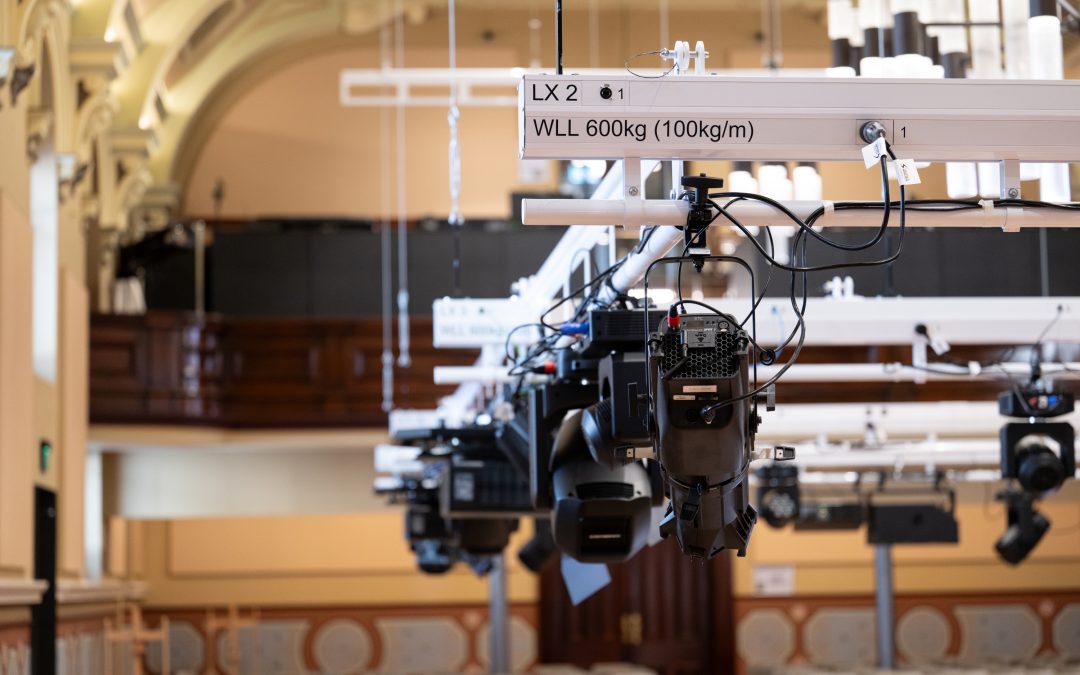
In this second article in our series relating to wired lighting bars and cabling, we will look at the phenomenon of earth leakage – how it occurs, how it affects circuit protection devices, and how this drives the circuit design of a contemporary wired lighting bar.
Lighting control systems have evolved from the (almost exclusive) use of dimmers, typically with a dimmer channel per outlet, to digital control of lighting fixtures that require fixed (not dimmed) mains power supplies.
The increasingly common use of LED theatrical luminaires means that the power required for a given light output can be as low as 15-20% of that required for incandescent fixtures.
This combination of fixed supply and reduced power means that it is possible to power a large number of fixtures on a single power circuit (although possible doesn’t necessarily mean advisable).
What is Earth Leakage Current?
A power circuit supplying a power point (ignoring the protective earth for the moment) consists of a live (Active) conductor and a return (Neutral) conductor. The current flowing to a power point (in the Active) should equal the current flowing from the power point (in the Neutral). If these currents are not the same, then part of the current flow is being diverted (leaking) to earth, hence “earth leakage”.
Leakage can occur from (a) equipment fault, (b) degraded cable insulation, (c) environmental factors (humidity), (d) by design (EMI filters), (e) an inherent condition (capacitance in power transformers & heatsinks) or (f) when a person touches a live circuit, diverting current to earth through the person’s body – an electric shock.
The imbalance between the Active and the Neutral current is the earth leakage current that is detected by a Residual Current Device (RCD). Such devices must disconnect the circuit from the supply when the earth leakage current is between 15mA (legal minimum) & 30mA (legal maximum) – typical values are around 20-25mA.
Protection of Lighting (Power) Circuits
The rules for protection of power circuits are similar in most jurisdictions. We will be using the Australian Wiring Rules (AS/NZS 3000 – 2018, Chapter 2 & Appendix B) as a reference.
Section 2.5 of AS/NZS 3000 requires that all power circuits be protected against overcurrent in such a manner that the circuit is disconnected from the supply before an overcurrent can cause injury or damage from excessive temperature buildup. (Overcurrent protection and circuit sizing will be the topic of later articles).
Section 2.6 of AS/NZS 3000 additionally requires “Additional Protection by Residual Current Devices” against the risk of electric shock from excessive earth leakage current.
Depending on where you are, you may see earth leakage protection devices referred to as an RCD, ELCB (Earth Leakage Circuit Breaker), RCBO (Residual Current Breaker with Overcurrent protection) or GFCI (Ground Fault Current Interrupter), but the earth leakage protection portion of these devices all work as described above.
The mandatory requirement for earth leakage protection, coupled with the move to LED fixtures that inherently generate increased levels (compared with incandescent fittings) of earth leakage, mean that protection against overcurrent/overloads and the current carrying capacity of lighting circuits are no longer the only requirements to consider when it comes to the design and specification of wired lighting bars.
In the next instalment in this series, we will explore some worked examples of the impact of these changes.
Disclaimer:
Whilst care is taken to provide current, correct and accurate content, all information is for general guidance only. We do not warrant the accuracy of information contained here-in, or on external websites, news & information services, web links or offers referred to in this material, nor is any responsibility assumed for third-party comments, information, products or services. No warranty or representation is given that products or services will be suitable for all situations. Any specific requirements must be confirmed directly with The P.A. People Pty Limited ACN 000 919 255.
For media inquiries or further information, please contact:
Jodie Steele
Ph: 0427 193 920
jodie.steele@papeople.com.au
www.papeople.com.au