
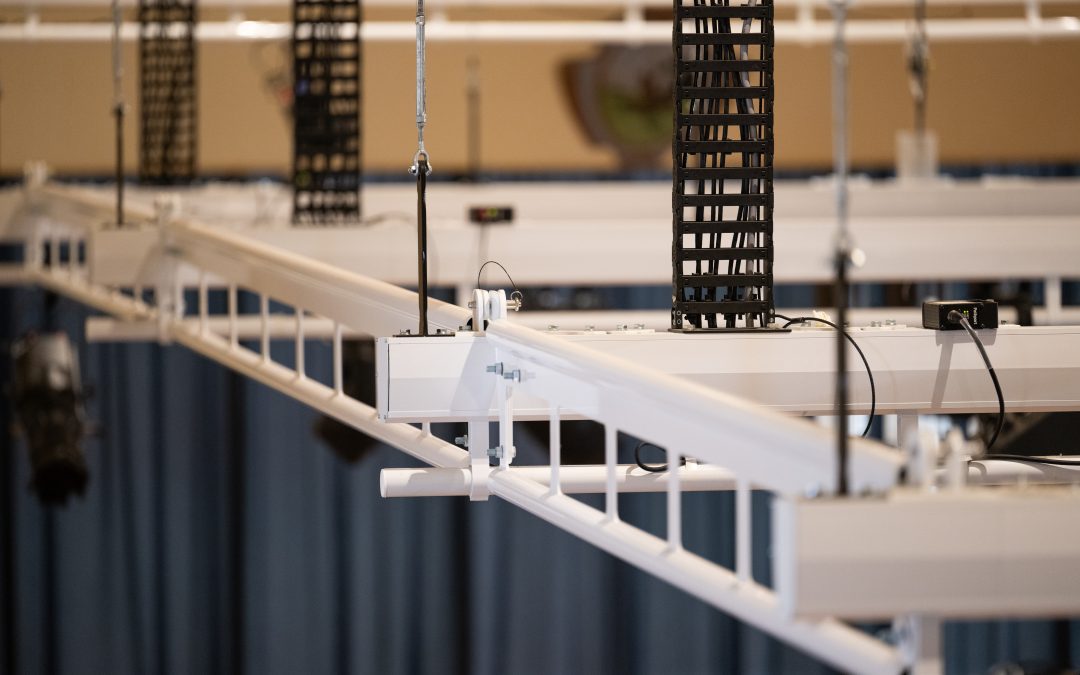
This is the first instalment in a new series exploring wired lighting bars and lighting bar cabling. Across the series, we’ll break down key technical considerations for practical use in your design decisions, in real-world environments.
In this opening article, we focus on earthing arrangements in lighting multicore cables – why they matter, how they work, and what to look out for. Future articles will expand on related topics including circuit loading, earth leakage, and other important factors that influence safe and reliable lighting infrastructure.
Earthing in multicore lighting cables
The question that we most commonly hear in relation to earthing of lighting multicore cables is whether or not it is permissible to used shared earthing conductor(s).
Firstly, there is no rule or regulation that states that you must have a separate earth per circuit, although this is by far the optimum arrangement and the one which requires the least amount of design work and carries the least risk.
Secondly, there is no rule or regulation that states that you must not share earths between circuits in a multicore cable, but as soon as you decide to do so, you take on the responsibility for the design of the earthing, and getting this wrong can lead to a significant risk of shock, cable damage or fire, that you will be unaware of until it is too late.
Providing a full-sized earth conductor for every circuit in the multicore is always the optimal solution, but this has historically entailed sourcing custom manufactured cables.
A change was made in the 2007 edition of the Wiring Rules (AS/NZS 3000, Clause 3.8.2 (c)) that now makes it permissible to sleeve conductors in a multicore cable with a Green/Yellow sleeve and to use these conductors as earth conductors, so separate earths can be achieved by using a multicore cable with 3 conductors per circuit, and sleeving to achieve the correct number of earths.
So, what if you are just stuck and you have to share earths?
Let’s consider a 12 core + earth cable with 75o insulation, where all the conductors are 2.5mm2 and we wish to use this cable for 6 x 10A circuits.
Check the current carrying capacity first by consulting AS/NZS 3008.1.1:2009.
Table 10, Column 6 = a single circuit rating of 25A & Table 22, Column 9 = de-rate factor of 0.57, for a nett current carrying capacity of 14.25A per circuit – all good.
Determine the minimum acceptable size and quantity for shared earth conductors.
If they are permanently connected (hardwired) to a 3-phase supplied dimmer, with 2 circuits on each phase, then we can model this arrangement as a single 20A 3 phase circuit.
This 3-phase circuit has active conductors of 2 x 2.5mm2. Adding these (5mm2). Rounding this up to 6mm2 (AS/NZS 3000:2018, Clause 5.3.3.1.2). The minimum required earth conductor size for 6mm2 active conductors (AS/NZS 3000:2018, Table 5.1) is 2.5mm2 – a single shared 2.5mm2 earth is OK.
If the circuits are patchable, then it may be possible to connect all 6 circuits to a single phase, so this arrangement needs to be modelled as single-phase 60A circuit.
This single-phase circuit has active conductors of 6 x 2.5mm2. Adding these (15mm2) and rounding up to 16mm2, we see the minimum required earth conductor size for 16mm2 active conductors is 6mm2 – a single shared 2.5mm2 earth is not OK.
We promise the next article will be a lighter read with less quoting of regulations!
Disclaimer:
Whilst care is taken to provide current, correct and accurate content, all information is for general guidance only. We do not warrant the accuracy of information contained here-in, or on external websites, news & information services, web links or offers referred to in this material, nor is any responsibility assumed for third-party comments, information, products or services. No warranty or representation is given that products or services will be suitable for all situations. Any specific requirements must be confirmed directly with The P.A. People Pty Limited ACN 000 919 255.
For media inquiries or further information, please contact:
Jodie Steele
Ph: 0427 193 920
jodie.steele@papeople.com.au
www.papeople.com.au